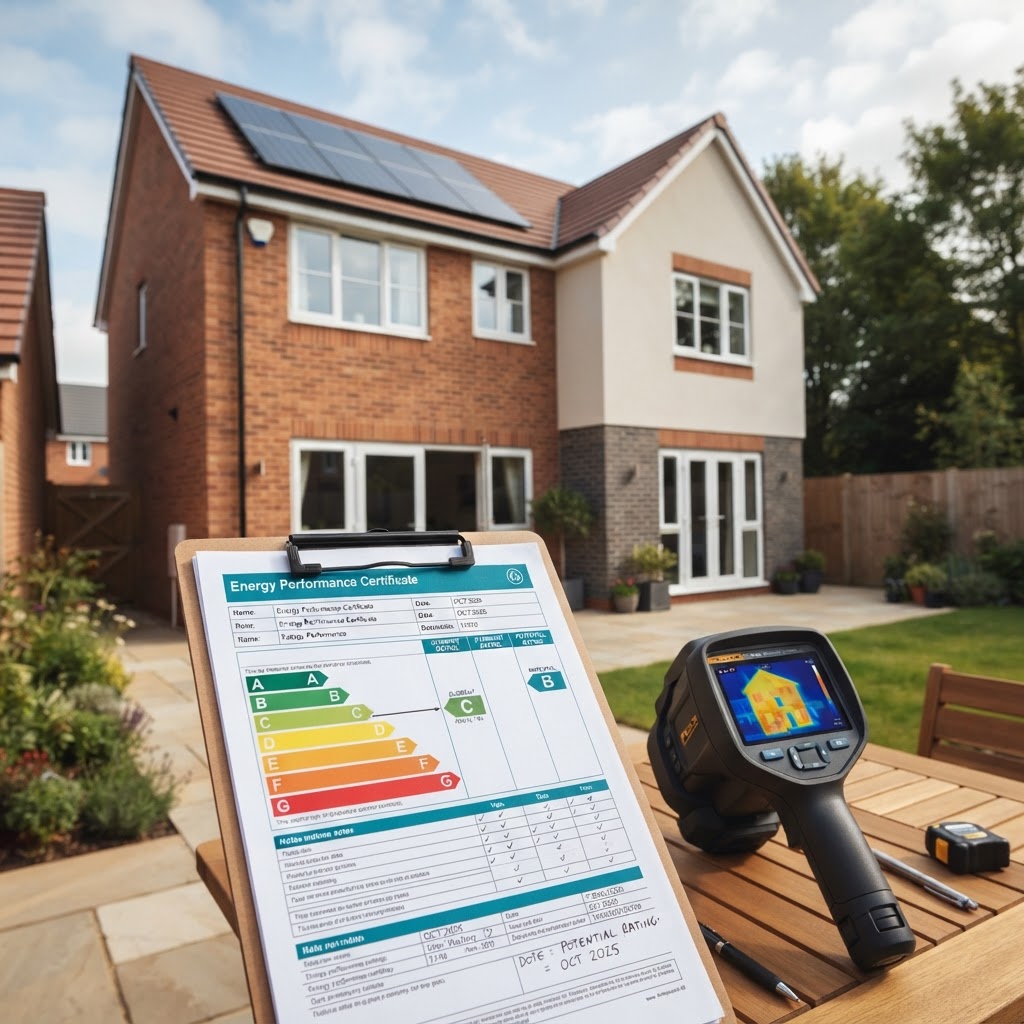
Home Energy Model and EPC Plans: A West Midlands Landlord Guide
Learn how planned Home Energy Model and multi-metric EPC reforms may affect property strategy across the West Midlands.
Regulatory position — 4 September 2026: Current domestic MEES in England and Wales requires EPC E unless a valid exemption applies. Government intends an EPC C-equivalent standard from 1 October 2030, but the higher standard, planned £10,000 cap and future £30,000 maximum penalty remain subject to further legislation and Parliamentary approval. Check current GOV.UK guidance.
The 2026 Home Energy Model: A West Midlands EPC Revolution
Introduction: The End of the SAP Era
As we move through 2026, the UK property market is preparing for major technical changes. While headlines have focused on the government's intended 2030 higher standard, a more immediate shift concerns how energy efficiency may be measured. According to recent reports from Citizens Advice, one-in-six Britons are currently taking drastic steps to cope with 'heat trap' homes in the summer and unaffordable bills in the winter. In response, the government is accelerating the rollout of the Home Energy Model (HEM), the successor to the long-standing Standard Assessment Procedure (SAP).
For property owners in Birmingham, Coventry, and the wider West Midlands, this isn't just a change in acronyms. The transition to HEM, combined with the introduction of dual-metric EPCs, represents a fundamental shift in how homes are valued, rented, and upgraded. With West Midlands house prices bucking the national trend—rising by 1.7% to an average of £265,126 in early 2026 according to Birmingham Live—understanding these new metrics is essential for protecting your investment. Whether you are a landlord in Dudley or a homeowner in Solihull, the way your property’s energy performance is calculated is about to change forever.
What is the Home Energy Model (HEM)?
The Home Energy Model (HEM) is a new, cloud-based methodology designed to replace SAP for the energy rating of dwellings. Unlike the old SAP system, which often relied on static assumptions and monthly averages, HEM is built to handle the complexities of a modern, decarbonised power grid. It uses half-hourly data to better reflect how energy is actually consumed in a home, particularly when low-carbon technologies like heat pumps and solar PV are involved.
For years, the industry has criticised SAP for the 'heat pump penalty'—a quirk in the calculation where switching from a gas boiler to a more efficient heat pump could actually result in a lower EPC score due to the higher unit cost of electricity compared to gas. The Home Energy Model is designed to fix this, providing a more accurate reflection of a property's true energy performance and its impact on the environment.
The Dual-Metric EPC: A Game Changer for Heat Pumps
One of the most significant updates arriving in 2026 is the move towards a dual-metric EPC. Under the current system, the headline A-G rating is primarily based on the cost of energy. The new reform, as highlighted by Mayer Brown, will likely split the certificate into two distinct scores:
- Energy Efficiency Rating: Focusing on the fabric of the building and how much energy it requires to stay warm.
- Environmental Impact/Carbon Rating: Focusing on the carbon emissions associated with the heating system.
This is vital for West Midlands landlords. Under the new rules, a property that is well-insulated (fabric first) but still uses a gas boiler might score well on efficiency but lower on carbon. Conversely, a property with a heat pump will no longer be 'punished' on its headline rating. The government has confirmed that private rented homes graded to an EPC 'C' or above before October 2029 will be treated as compliant until that certificate expires, providing a clear incentive to act now using our EPC assessment services.
The West Midlands Context: Resilience and Retrofit
The West Midlands is currently a focal point for the UK’s retrofit revolution. While national house prices have seen volatility, the region remains resilient. However, the age of the housing stock in areas like Walsall, Wolverhampton, and Stafford presents a challenge. Many Victorian and Edwardian terraces require significant 'fabric first' interventions—such as internal or external wall insulation—to prepare for the government's intended 2030 EPC C-equivalent standard.
Birmingham City Council has recently secured a £10.3 million retrofit programme under the Warm Homes Local Grant, as reported by Next Energy. This funding is specifically targeted at low-income households and high-deprivation areas, offering fully funded measures including insulation, solar panels, and heat pumps. For landlords in these areas, this represents a unique window to upgrade portfolios without the full capital outlay, provided their tenants meet the eligibility criteria.
The Government's Intended 2030 Roadmap
The January 2026 government response sets out an intended single compliance date of 1 October 2030 for an EPC C-equivalent standard across new and existing tenancies. The higher standard remains subject to further legislation and Parliamentary approval:
- 2026: The Home Energy Model (HEM) and dual-metric EPCs are officially launched. Landlords should book a retrofit assessment to see how their properties fare under the new methodology.
- 2027: The Warm Homes Plan enters its next phase of funding, with a headline budget of £15 billion across the parliament.
- 2028: The proposed 'Mansion Tax' adjustments begin to influence the higher end of the market, making energy efficiency a key selling point for £2m+ properties in areas like Solihull and Sutton Coldfield.
- 2029: The 'grace period' for existing EPC C certificates ends. Any new EPCs issued from this point must meet the C standard.
- 2030: Intended compliance date of 1 October 2030, subject to legislation; qualifying properties would need to meet the higher standard or register a valid exemption.
The £10,000 Cost Cap
Crucially, the government has introduced a £10,000 cost cap per property. If the cost of reaching EPC C exceeds this amount, landlords can apply for a 10-year exemption, provided they have spent up to the cap on eligible measures. This is why accurate, professional assessments are vital; you must evidence that the work has been quoted and the cap reached to qualify for the exemption.
Funding the Future: Grants in Birmingham and Beyond
Navigating the grant landscape can be complex, but for West Midlands residents, there are several key routes to funding:
- Warm Homes Local Grant: Managed by local authorities like Birmingham City Council. Eligibility includes living in a high-deprivation postcode or having a gross annual income under £36,000. Measures covered include insulation and solar PV.
- ECO4 & GBIS: These schemes continue to focus on a 'whole-house' approach. Under ECO4, properties in SAP bands E, F, or G must be improved to at least a D or C. You can check your grant eligibility through our dedicated portal.
- Boiler Upgrade Scheme (BUS): With the Chancellor recently announcing £13.2 billion for the Warm Homes Plan, the BUS remains a primary route for those looking to install air source heat pumps, offering substantial vouchers to offset installation costs.
Practical Steps for Property Owners
If you own property in Coventry, Dudley, or Stafford, here is how to prepare for the HEM transition:
- Prioritise Fabric First: Before looking at expensive heating systems, ensure your loft, floor, and wall insulation are up to standard. This is the most cost-effective way to boost an EPC rating under the new model.
- Audit Your Portfolio: Don't wait until 2029. A RICS Level 2 or Level 3 survey can now include specific energy advice. Explore our RICS survey packages to combine structural peace of mind with energy planning.
- Check Your Metrics: When you receive a new EPC in 2026, look closely at the dual metrics. A high carbon score but low efficiency score suggests you need better insulation, not a new boiler.
- Professional Inventories: As rental regulations tighten, ensuring your property’s condition is documented is more important than ever. Our property inventory services help protect landlords during the upgrade process.
What This Means for Birmingham & West Midlands Property Owners
The West Midlands is uniquely positioned. With a 1.7% rise in property values recently, there is equity in many homes that can be leveraged for improvements. However, the 'Brown Discount'—where energy-inefficient homes sell for significantly less—is becoming a reality. Buyers in 2026 are data-led and cautious; they are looking at EPC ratings as a proxy for future running costs.
In Birmingham, the £10.3m retrofit pot is a call to action. If you are a landlord in a high-deprivation area of the city, you could potentially reach the 2030 EPC C standard at zero cost to yourself. In more affluent areas like Solihull, the focus should be on 'Green Mortgages,' which now offer measurable rate discounts for properties that meet the new HEM standards.
Why Choose Skyline Technical Services?
At Skyline Technical Services, we are more than just surveyors; we are your partners in the energy transition. Serving Birmingham, Coventry, Wolverhampton, Walsall, Dudley, Solihull, Stafford, and the wider West Midlands, we bring local expertise to a national challenge.
- Expert Assessors: Our team is fully trained in the new Home Energy Model (HEM) and PAS 2035 standards.
- Local Knowledge: We understand the specific construction types of West Midlands housing, from Stafford’s rural cottages to Birmingham’s back-to-back heritage.
- Comprehensive Support: From EPCs and retrofit assessments to RICS surveys and inventories, we provide a end-to-end service for landlords and homeowners.
FAQs
Q: Will my current EPC remain valid after the Home Energy Model (HEM) launches? A: Yes, your existing EPC remains valid until its expiry date (usually 10 years from issue). For landlords, the government's intended 2030 higher standard may make a future assessment under the new methodology useful, but the detailed legal requirements are not yet in force.
Q: Does the £10,000 cost cap include VAT? A: The cost cap generally refers to the total spend on energy efficiency improvements. Recent government guidance suggests that landlords should keep all receipts and VAT invoices as evidence for exemption applications.
Q: Can I get a grant if my property is already an EPC D? A: Yes. Many schemes, including the Warm Homes Local Grant and ECO4, target properties in bands D through G. The goal is to lift these properties to a C rating.
Q: How does the 'dual-metric' EPC help me if I have a gas boiler? A: It provides clarity. It will show that while your carbon emissions might be higher, your building's fabric efficiency (insulation) is good. This helps buyers and tenants understand that the property is 'heat pump ready' even if one isn't installed yet.
Ready to future-proof your property? Contact Skyline Technical Services today to book your 2026-ready assessment.
Ready to take action?
Get a fast, no-obligation quote from our accredited team — covering EPCs, surveys, retrofit and more.
Related Articles
EPC C Deadline: Why Your Rating Impacts Property Value
Discover how the 2030 EPC C deadline is reshaping West Midlands property values and why energy efficiency is now a critical asset-management strategy.
EPC C by 2030: A Landlord’s Action Plan for the West Midlands
Prepare your rental portfolio for the 2030 EPC C deadline. Learn how to navigate the £10,000 cost cap, new methodology shifts, and West Midlands grant support.