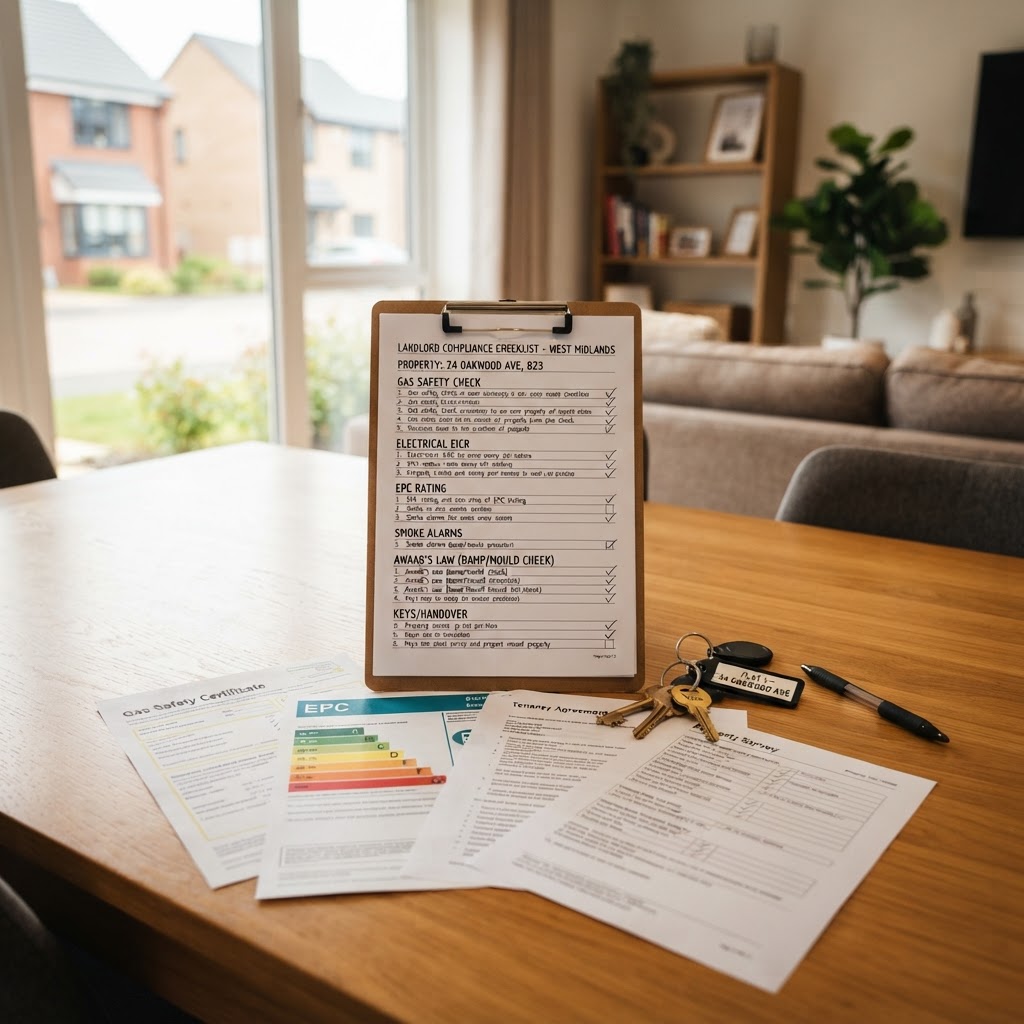
Awaab's Law & Decent Homes: A West Midlands Landlord Guide
New laws are extending Awaab's Law and the Decent Homes Standard to the West Midlands rental market. Learn how to stay compliant and protect your property.
Awaab's Law and the New Decent Homes Standard: A Survival Guide for West Midlands Landlords
The landscape of the UK rental market is undergoing its most significant transformation in a generation. In the past fortnight, the government has reaffirmed its commitment to the Renters' Rights Bill, a legislative powerhouse designed to overhaul the Private Rented Sector (PRS). Central to this change is the historic extension of Awaab’s Law and the Decent Homes Standard to private tenancies—a move that will directly impact every landlord from the Victorian terraces of Birmingham to the suburban semis of Solihull.
For property owners across Coventry, Wolverhampton, and the wider West Midlands, these changes are not merely administrative; they are legal mandates with teeth. The days of 'patch and mend' repairs for damp and mould are over. As the government pivots toward a more rigorous enforcement of living standards, landlords must understand their new obligations to avoid eye-watering fines and legal action. This guide breaks down exactly what you need to know to keep your West Midlands property compliant, safe, and profitable.
What is the Decent Homes Standard for the Private Rented Sector?
Historically, the Decent Homes Standard applied only to social housing. It set a benchmark for what constitutes a 'liveable' property, focusing on four key criteria: meeting the current statutory minimum for housing health and safety, being in a reasonable state of repair, having reasonably modern facilities, and providing a reasonable degree of thermal comfort.
Under the new Renters' Rights Bill, this standard is being ported over to the PRS. For landlords in areas like Walsall, Dudley, and Stafford, this means that having a valid our EPC assessment services is just the beginning. Your property will now be judged on a much broader range of criteria that ensure the building is fit for human habitation. If a property fails to meet the Decent Homes Standard, local authorities in the West Midlands will have the power to issue improvement notices or even ban the property from being let.
The Four Pillars of Decency
- Statutory Minima: The property must be free from 'Category 1' hazards under the Housing Health and Safety Rating System (HHSRS). This includes issues like structural instability, extreme cold, and significant damp.
- State of Repair: The building components (roof, walls, windows) must not be old and in poor condition.
- Modern Facilities: This includes reasonably modern kitchens (usually less than 20 years old) and bathrooms (less than 30 years old), and adequate noise insulation.
- Thermal Comfort: The property must have efficient heating and effective insulation. This is where book a retrofit assessment becomes vital for older stock in Birmingham and Wolverhampton.
Understanding Awaab’s Law: The Clock is Ticking on Damp
Awaab’s Law was born out of the tragic death of two-year-old Awaab Ishak, who died from a respiratory condition caused by extensive mould in his social housing flat. The extension of this law to the private sector means that landlords are now legally bound by strict timelines to address damp and mould.
In the West Midlands, where many rental properties are converted industrial dwellings or pre-war terraces, damp is a persistent issue. Under Awaab’s Law, once a tenant reports damp or mould, the landlord must:
- Investigate within 14 days: You must carry out a professional assessment to determine the cause of the moisture.
- Provide a report within 48 hours: After the investigation, you must share the findings with the tenant.
- Begin repairs within 7 days: If the damp is found to pose a risk to health, remediation work must commence within a week.
- Emergency repairs in 24 hours: If the risk is imminent, the timeline drops to just one day.
Failure to adhere to these timelines can result in tenants taking their landlords to court for breach of contract, or local councils in Coventry and Dudley issuing massive civil penalties.
The Financial Stakes: Fines and Rent Repayment Orders
The enforcement of these new standards is backed by significant financial deterrents. West Midlands local authorities are being granted increased powers to fine landlords who fail to meet the Decent Homes Standard or ignore Awaab’s Law.
- Civil Penalties: Local councils can issue fines of up to £7,000 for non-compliance with the Decent Homes Standard.
- Rent Repayment Orders (RROs): Tenants may be able to claim back up to 12 months of rent if their landlord has failed to comply with improvement notices related to damp, mould, or general safety.
- The 'Blacklist': Persistent offenders will be added to a national database of rogue landlords, making it nearly impossible to obtain landlord insurance or professional property management services.
Why the West Midlands is at Higher Risk
The West Midlands poses unique challenges for these new regulations. In Birmingham and Wolverhampton, a significant portion of the rental stock consists of 'solid wall' Victorian and Edwardian homes. These properties were designed to 'breathe' through open fireplaces and sash windows. When modern living habits (like drying clothes indoors) meet modern 'sealing' (like uPVC windows without trickle vents), damp and mould are the inevitable result.
Furthermore, areas like Walsall and Stafford have a high density of older housing that often lacks the 'thermal comfort' required by the Decent Homes Standard. Without a proper property inventory services check-in that notes the condition of ventilation and insulation, landlords are at risk of being blamed for moisture issues that are inherently structural.
The Energy-Damp Connection: Retrofitting as a Solution
The most effective way to comply with both the Decent Homes Standard and Awaab's Law is to improve the building's fabric. A cold home is a damp home. When walls are cold, moisture in the air condenses on them, leading to mould growth. By improving insulation and heating, you raise the internal surface temperature of the walls, preventing condensation.
This is where current government grants provide a lifeline. Landlords in the West Midlands should check your grant eligibility for schemes like:
- ECO4 (Energy Company Obligation): Provides funding for heat pumps, solar panels, and solid wall insulation for low-income tenants.
- GBIS (Great British Insulation Scheme): Focuses on single-measure insulation like loft or cavity wall upgrades, which can significantly improve a property’s Decent Homes rating.
- The Warm Homes Plan: The new government's flagship scheme aimed at boosting energy efficiency in both social and private sectors.
Practical Compliance Checklist for Landlords
To prepare for the full rollout of the Renters' Rights Bill and Awaab's Law, West Midlands landlords should take the following steps immediately:
- Conduct a Proactive Damp Audit: Don't wait for a tenant to complain. Arrange for a professional to inspect your properties in Birmingham or Coventry for signs of penetrating or rising damp.
- Upgrade Ventilation: Ensure all bathrooms and kitchens have mechanical extraction fans that meet current building regulations. Consider installing PIV (Positive Input Ventilation) systems in older West Midlands terraces.
- Review Your RICS Surveys: If you are purchasing a new rental property, ensure you opt for comprehensive RICS survey packages that specifically highlight HHSRS risks.
- Update Tenant Handbooks: Educate tenants on how to minimise moisture (e.g., using extractor fans, not blocking air bricks) but remember that under Awaab's Law, 'lifestyle' is no longer an excuse for structural damp issues.
- Monitor Your EPC Rating: Aim for a high 'C' rating. This not only prepares you for future 2030 deadlines but also proves you are meeting the 'thermal comfort' requirement of the Decent Homes Standard.
What This Means for Birmingham & West Midlands Property Owners
In the West Midlands, property is more than just an asset; it's a vital part of our local economy. However, the 'old way' of managing property—waiting for something to break before fixing it—is no longer viable. Local councils across the West Midlands Combined Authority are becoming more aggressive in their inspections.
In Birmingham, the selective licensing schemes already in place mean that the council has a list of properties they intend to inspect. If your property is in a licensing zone, you are in the front line for Decent Homes Standard enforcement. By acting now—conducting a retrofit assessment and upgrading insulation—you can move your property from a liability to a compliant, high-value asset.
Why Choose Skyline Technical Services?
Navigating the overlap between the Renters' Rights Bill, Awaab's Law, and the Decent Homes Standard is complex. Skyline Technical Services is uniquely positioned to help West Midlands landlords stay ahead of the curve.
We provide a full suite of technical property services across Birmingham, Coventry, Wolverhampton, and Stafford. Unlike generic providers, we understand the specific nuances of West Midlands housing stock. Whether you need a rapid-turnaround EPC assessment to check your thermal comfort or a detailed PAS 2035 compliant retrofit assessment to plan your damp-proofing strategy, our team is here to help. We bridge the gap between compliance and quality, ensuring your property isn't just 'decent' on paper, but a safe, warm, and legal home for your tenants.
Frequently Asked Questions
Q: Does Awaab's Law apply if the tenant is responsible for the mould? A: Under the new regulations, the burden of proof is on the landlord. You must investigate within 14 days regardless of who you think is at fault. If the damp is caused by structural issues or poor ventilation, it is your responsibility to fix it. If it is purely 'lifestyle', you must still provide a report and potentially improve the property's ability to handle moisture.
Q: How do I know if my property meets the Decent Homes Standard? A: A professional surveyor can conduct an HHSRS assessment to check for the 29 hazards identified by the government. Generally, if your property is free from damp, has a modern boiler, and is well-insulated, you are likely compliant.
Q: Are there any grants available to help West Midlands landlords with these costs? A: Yes. Depending on your tenant's income or the property's EPC rating, you may be eligible for the ECO4 or GBIS schemes. These can cover the cost of insulation and heating upgrades. You can check your grant eligibility on our website.
Q: Is the 2030 EPC C deadline still happening? A: Yes, the current government has confirmed that the target for all rental properties to reach EPC C by 2030 is back on the table. Improving your property now to meet the Decent Homes Standard will also help you reach this EPC goal.
Protect Your Investment Today
Don't wait for a council inspection or a legal challenge. Ensure your West Midlands rental property is fully compliant with the new Decent Homes Standard and Awaab's Law. Contact Skyline Technical Services today for a professional assessment.
Ready to take action?
Get a fast, no-obligation quote from our accredited team — covering EPCs, surveys, retrofit and more.
Related Articles

Are letting-agent fees rising after the Renters’ Rights Act?
Reports suggest some landlords face new letting-agent charges after the Renters’ Rights Act. See what is confirmed, what is reported and what to check.

Private Rented Sector Database: Records to Prepare
The Private Rented Sector Database is planned from late 2026. Here are the property and compliance records landlords should organise now.