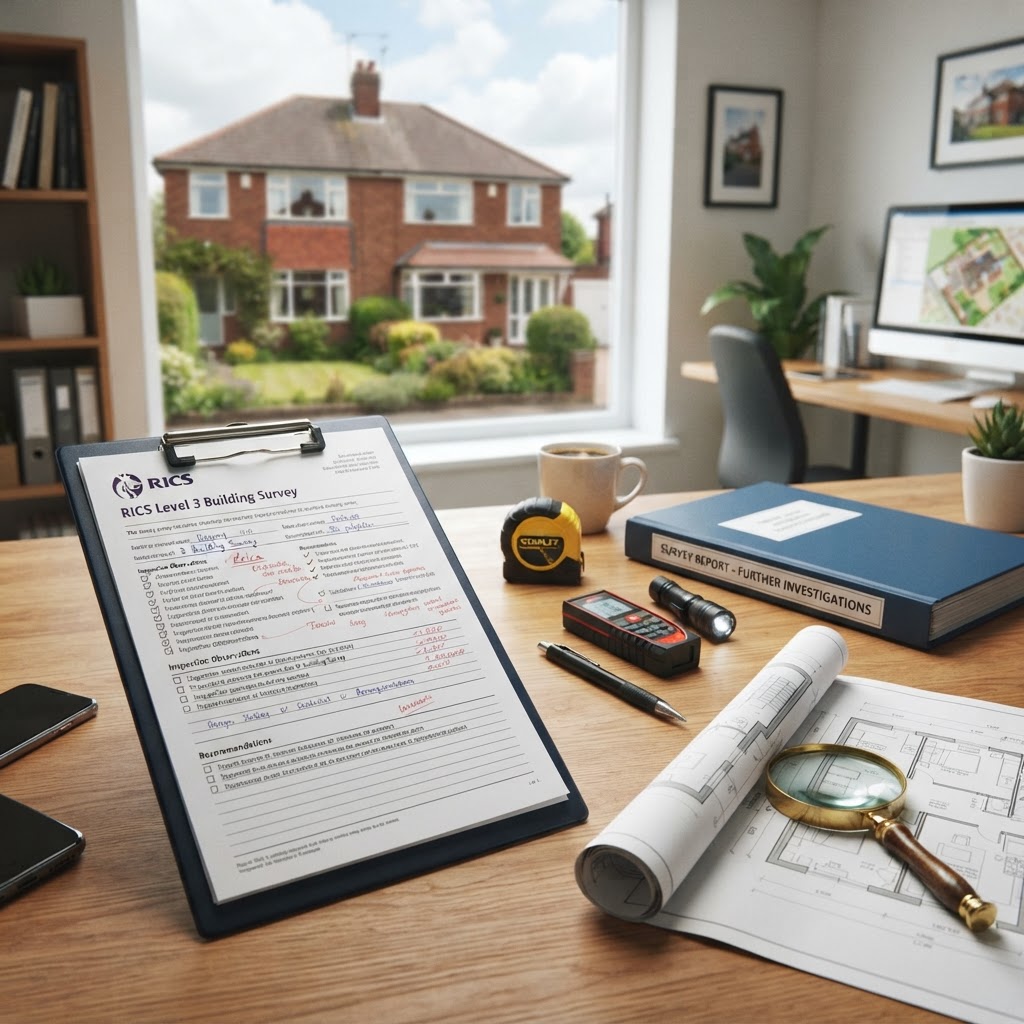
RICS Level 3 Survey: Handling 'Further Investigations'
Learn how to handle 'further investigations' in a RICS Level 3 survey. Our guide covers West Midlands property defects, specialist quotes, and price negotiations.
RICS Level 3 Survey: Handling 'Further Investigations' in the West Midlands
Receiving a RICS Level 3 Building Survey report is a pivotal moment in any property transaction. For buyers in Birmingham, Wolverhampton, or the wider West Midlands, this document is the definitive word on a building's health. However, many buyers are caught off guard when, despite paying for the most comprehensive survey available, the report concludes with a list of "further investigations" required.
It is a common misconception that a Level 3 survey is an exhaustive end-point. In reality, as defined by the Royal Institution of Chartered Surveyors (RICS), a Level 3 survey is designed to identify significant defects and advise on repairs, but it also serves as a diagnostic tool that flags when a specialist’s eye is needed for hidden or highly technical elements.
In the current West Midlands market—where the RICS February 2026 Residential Survey shows a cautious near-term price outlook but resilient long-term sentiment—understanding how to navigate these recommendations is the difference between a collapsed sale and a secured investment.
Why Surveyors Recommend Further Investigations
A RICS Level 3 survey is a thorough visual inspection. However, surveyors are general practitioners of the building world. They are experts at spotting the symptoms of a problem, but they may require a specialist to confirm the cause or the exact cost of the cure.
According to RICS professional standards, further investigations are recommended when:
- Parts of the property are inaccessible: For example, if a loft is heavily insulated or floorboards are screwed down, the surveyor cannot inspect the timbers beneath.
- Specialist equipment is required: Surveyors do not typically carry CCTV drain cameras or perform invasive "destructive" testing.
- The defect is outside their remit: A surveyor can spot a crack, but a structural engineer is needed to calculate if that crack indicates a foundation failure.
Common 'Further Investigation' Triggers in West Midlands Housing
The West Midlands has a diverse housing stock, from Victorian terraces in Smethwick to industrial-era conversions in Birmingham’s Jewellery Quarter and post-war semis in Solihull. Each brings specific risks that often trigger further checks.
1. Structural Movement and Subsidence
In areas like Dudley and Sandwell, historical mining activity is a known factor. If a surveyor notes "deflections outside of acceptable tolerance," they will likely recommend a Structural Engineer's inspection to identify the cause and remedial works. This is critical for securing a mortgage, as lenders will often pause an application until the structural integrity is confirmed.
2. Damp and Timber Decay
Older properties in Coventry and Stafford often suffer from rising or penetrating damp. A surveyor might use a moisture meter to find high readings but will recommend a specialist damp and timber survey to determine if the issue is simple condensation, a failed damp-proof course, or something more serious like dry rot in the floor joists.
3. Drainage and Sewers
Many West Midlands homes built before 1920 share "combined" drainage systems. If the surveyor notes slow drainage or signs of ground movement near manholes, a CCTV drain survey is often recommended. This is a low-cost investigation that can prevent multi-thousand-pound repairs later.
4. Electrical and Gas Safety
While a RICS Level 3 survey includes a visual check of the consumer unit and boiler, it is not a safety test. Surveyors will almost always recommend an EICR (Electrical Installation Condition Report) and a Gas Safety Record, especially in older properties where wiring may not meet current 18th Edition Wiring Regulations.
The RICS Level 3 Energy Section and Retrofit Standards
A significant addition to modern RICS reporting is the focus on energy efficiency. While the surveyor does not prepare a new EPC as part of the standard service, they will review the existing EPC and explain its implications.
With the RICS Retrofit Standard now in full effect, surveyors are increasingly looking at how a property can be improved to meet future net-zero targets. If you are buying a property with a low EPC rating (D or below), the Level 3 report may recommend a PAS 2035 Retrofit Assessment. This is particularly relevant for West Midlands landlords who must prepare for the 2030 EPC C deadline.
Step-by-Step: How to Manage Survey Recommendations
If your report comes back with "Red Light" (Condition Rating 3) items requiring further investigation, follow this workflow to protect your purchase.
Step 1: Prioritise the Risks
Not all recommendations are equal. A recommendation for an electrical check is standard; a recommendation for a structural engineer is a priority. Categorise the findings into "Safety/Structural" (must do now) and "Maintenance/Improvement" (can do later).
Step 2: Source Independent Specialists
When approaching contractors for these investigations, RICS advice is clear: ask for references, get quotes in writing, and ensure they are independent. Avoid using a damp-proofing company that also sells the treatment, as their "investigation" may be biased toward selling you a product you don't need.
Step 3: Use the Evidence to Negotiate
Once you have the specialist reports and written quotes, you are in a strong position to negotiate the purchase price. If a Level 3 survey identifies £10,000 of necessary structural work, it is standard practice to ask the seller to either carry out the repairs before completion or reduce the sale price by the equivalent amount.
Step 4: Check Planning and Building Regs
If the further investigation reveals that previous work (like a loft conversion or an extension) was done poorly, check if it received Building Regulations permission. A RICS Level 3 survey will often flag where "lack of evidence" for these permissions exists, requiring your solicitor to investigate further.
Local Application: West Midlands Property Nuances
In the West Midlands, the "Further Investigation" phase often uncovers regional specificities:
- Birmingham & Solihull: High demand for 1930s semis often reveals issues with "non-traditional" construction types (like BISF houses) which require specialist RICS Level 3 knowledge to value correctly.
- Wolverhampton & Walsall: Industrial heritage means ground contamination or old "filled" land can occasionally be flagged, requiring a desktop environmental search.
- Staffordshire: Older rural properties may have unmapped septic tanks or private drainage that require a specialist environmental engineer.
How Skyline Technical Services Can Help
At Skyline Technical Services, we bridge the gap between a standard survey and the "further investigations" phase. We provide comprehensive RICS survey packages across Birmingham, Coventry, and the West Midlands, designed to give you the most detailed picture possible from the start.
Our approach includes:
- Integrated Evidence: We use 360° virtual tours and high-resolution digital twins to document defects, allowing you to show specialists exactly what the surveyor saw without needing multiple site visits.
- Retrofit Ready: Our surveyors are trained in the latest PAS 2035 Retrofit Assessment standards, ensuring that energy-related "further investigations" are handled with a view toward future compliance and grant eligibility.
- Landlord Support: For investors, we combine RICS surveys with landlord compliance records, ensuring that your "further investigations" also cover gas, electric, and fire safety requirements.
Don't let a "further investigation" recommendation stall your property plans. Use it as a tool to ensure you are paying a fair price for a safe home.
Frequently Asked Questions
1. Does a Level 3 survey include a valuation?
Not by default. A RICS Level 3 Building Survey focuses on condition and structure. However, a professional valuation can often be added as an extra service. At Skyline, we offer pricing for combined survey and valuation packs.
2. How much do further investigations cost?
It depends on the specialist. A CCTV drain survey might cost £150–£300, while a full Structural Engineer’s report could range from £500 to £1,500. Always get a quote before proceeding.
3. Can I ignore the further investigation recommendations?
You can, but it is risky. If you ignore a recommendation for a structural check and the house later develops major cracks, you will have no recourse against the surveyor or the seller. Furthermore, your buildings insurance may be void if you were aware of a defect and failed to act.
4. How long do these extra checks take?
In the West Midlands, most specialists (damp, electrical, or drainage) can attend within 5–10 working days. Structural engineers may have longer lead times. It is vital to inform your solicitor and the seller's agent to prevent the chain from breaking.
5. What if the seller refuses access for further investigations?
This is a major red flag. If a seller refuses to allow a specialist to check a flagged defect, you must consider whether the risk of the unknown is worth the investment. Most reasonable sellers will allow access if it means keeping the sale on track.
Ready to take action?
Get a fast, no-obligation quote for EPCs, inventories, inspections and property-record support across the Midlands.
Related Articles

Property Survey for Old Buildings: 1930s House Guide
Planning to buy a 1930s home? Learn why a professional property survey is essential for identifying common issues like damp, structural movement, and energy loss.

RICS Survey vs HomeBuyer Report: Which Should You Choose?
Confused between a RICS survey vs HomeBuyer report? Learn the key differences to make the right choice for your property purchase in the West Midlands.